Wednesday, March 25, 2015

Kobe

Adam and I went to Kobe on Saturday.  It was a full day!  We took a train at 7:00 am and arrived in Kobe a little after 9:30am.  Thankfully, we were able to sit the whole ride despite the trains being very full.  It’s amazing how many people are going places early on a Saturday morning. 

Our first stop was the Hakutsuru Sake Brewery.  As we were walking from the station to the brewery, lo and behold a Catholic Church!  Now, if you’re travelling in Europe and you come across a Catholic Church it’s no surprise.  In fact, you’d be more surprised not to see one.  But in Japan, to come across a Catholic Church is special!  The church was open too, so we were able to spend some time with Jesus.  After leaving the church, getting lost, asking for directions, finding our way, we arrived at the sake brewery.  There’s 4 or 5 breweries in the area, but this one had good reviews.  They have a free museum that shows how sake used to be made and how it’s made now.  They had English pamphlets and English videos!  Making sake was a lot of work and quite the work out too; now, they get machines to do most of the work.  After we learned about the sake making process, we came to the end of the museum.  Before you exit, there’s a gift shop with free sake tasting.  We tasted 4 different kinds of sake.  Two were normal kinds, one was lemon sake, and the last one was plum sake.  This might have been the highlight of my day, partly because the information was in English and because it’s such a unique experience specific to Japan.
St. Paul Miki

Peach Blossoms 


Hakutsuru Brewery Museum


No, these guys aren't real.  


That's a big barrel.

Cooling the rice


Packaging the sake


They would put the rice in these bags and then press them.
The liquid (sake) coming out would go through this strainer.  

We jumped back on the train and rode into downtown Kobe.  We have this train pass (Seishun 18) that allows unlimited train travel on local trains for one day and we really made good use of it since they have local trains running within Kobe every five minutes.  We also used the pass to get to Kobe and back to Tarui.  We got off the train and walked to city hall.  I felt like I was in Europe.  I think I tend to feel like that when the weather is nice, I’m in a big city, and there’s people all around. Anyways, at city hall you can go up to the 24th floor and there’s an observation deck for free.  You don’t get the whole 360 degree view, but you can look out towards the ocean and the mountains. 


On our way to City Hall.


Next, we walked to the Merikan Park port area and had a picnic lunch.  In 1995, Kobe had a really bad earthquake.  Over 6000 people died and it caused a lot of damage.  We had our picnic right by a little outdoor museum explaining the earthquake and the rebuilding process.  They have an area that they didn’t rebuild so that people can see how devastating the earthquake was.


Area that they didn't rebuild.
Then, we went to the Kobe Maritime Museum which really wasn’t worthwhile.  They have a section on Kawasaki since it started in Kobe, but even that wasn’t as impressive as the reviews sounded.  If you had little kids it might be a cool place to go to.  In fact, we might have been the only people there without children.  I think the fact that all the kids were busy doing the interactive parts of displays made us feel a little sheepish about trying them out.  Imagine: two foreign white adults waiting in a line of kids to get to try something. J  One interesting thing I learned at the museum was that back in the 12th century the Shogun at the time ordered an island to be built off of Kobe.  That island is still being used as part of the port.  I just thought it was funny, like why would you order an island to be built?  The model they had of the island-building made it seem even funnier.  The Shogun was twice the size of any of the other people in the display and he had an angry face.  No one else had a face and they were all working hard moving rocks while being ordered on by the angry Shogun.  Maybe there was more of an explanation in Japanese as to why the island was built.


Kawasaki motorcycle
 At this same Meriken Park area, they have a giant mall.  It’s kind of cool and also extremely overwhelming especially with so many people all around.  We bought Adam some sunglasses and left.
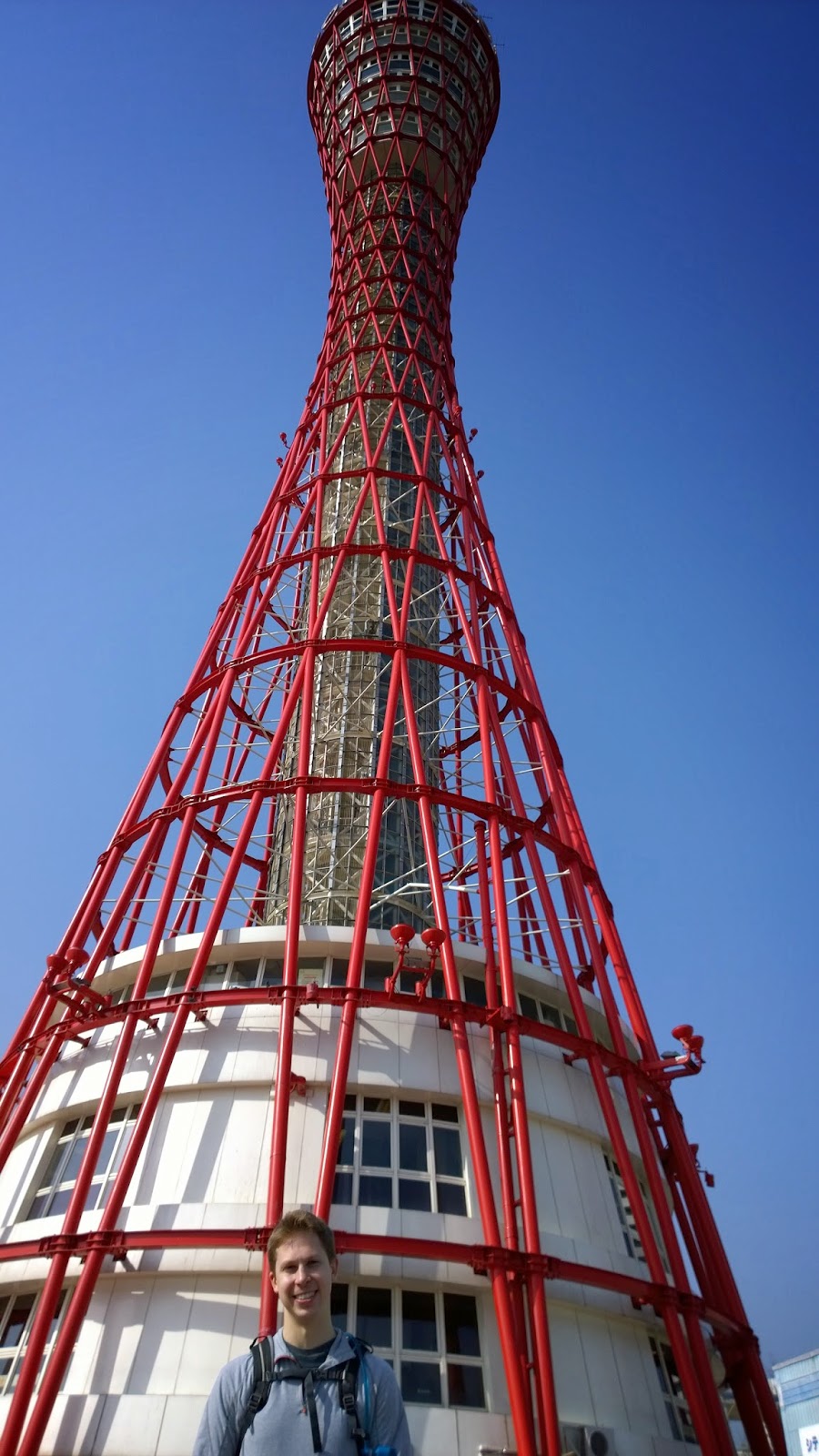

Kobe Tower


Between buildings inside the mall.
Our last stop of the day was Suma Beach.  I had a few other things planned, but we didn’t have the time or energy for them.  We just hung out at the beach and ate our supper.  It was a relaxing way to end the day and get away from the noise of downtown Kobe.  We listened to the waves come in and watched the fish jump and believe me, they were doing a lot of jumping.  Every few seconds, we’d see them jumping all over the place.

 I had planned for us to go see this suspension bridge that has the longest central span of any suspension bridge in the world at 1.9km.  The whole bridge is 3.9km.  We could see part of it from Suma beach and were both satisfied.


On Sunday, we were invited over to a friend’s house for lunch.  They had a takoyaki party.  Takoyaki is an octopus dough ball.  As you can see we also got to taste a bunch of other delicious dishes.  The other people we met could speak English too, so it was a nice social event for us.
Takoyaki being cooked.


Monday, March 16, 2015

Hachisu School Play

On Sunday, we went to the Hachisu Children Centre’s year end performance of The Wizard of Oz.  We had been invited by the lady who runs the school and had reserved seats near the front.  We were cordially escorted to our seats and given a gift.  She also came and greeted us.  We are pretty important people here in Tarui J.  Hachisu has children ages 2 to 5 and they really focus on their English program.  The first part of the performance consisted of the kids playing different musical pieces which was well done and really cute.  They gave the two year olds some clapper type things and they sometimes hit them at the right time, sometimes just stood there looking at all the people, and sometimes just hit it randomly.  The second half of the program was a full two hour play of the Wizard of Oz.  The main characters were played by grade 6 students from different elementary schools.  They also had some adults, junior high, and elementary students take part.  It was really incredible to see how they involved so many people. It was extremely well done.  The set was made of paper and cardboard and many of the costumes were homemade too.  The whole play was done in English which was great for us, but I’m not sure how much anyone else got out of it.  I can’t imagine how hard it must have been for the main characters to memorize their lines.  As you can see from the pictures, it was really cute and we were glad we got to participate in this community event. 


Munchkins


The flying monkey army


Nara

We have had a very busy weekend, if I do say so myself.  On Saturday, we got up nice and early and caught the 7:43 train going to Nara.  Nara was the capital of Japan from 710 to 794 and during that period temples and shrines were built.

                When we arrived, we went to Kofukuji Temple.  The temple is made up of multiple buildings including a 3 and 5 story pagoda, a couple octagon shaped buildings, a main hall, and a museum.  As soon as we climbed up the steps we saw a man with a sign advertising free tours.  As I read the sign, he offered us a free tour.  I asked at what time and he said that we could start right now.  Adam and I ended up getting a free hour and a half tour of this temple (even though he advertised just 20 minute tours).  I guess he’s a part of a group of volunteers who give tours to foreign tourists.  I think they do it to practice their English.  He was a really good tour guide and was able to answer almost all of our questions and we learned a lot about Buddhism.  He explained who and what various statues were in the temple and the museum.  Some of the statues we saw were made in the eighth century!  If we would have been by ourselves, we wouldn’t have been able to read anything and wouldn’t have appreciated this experience nearly as much. 

Three Story Pagoda

This Buddha or Bodhisattva brings the children who have died young up from "hell."
 Parents put the red cloths on the stones to thank him. 

Main Hall

Five Story Pagoda
The second tallest in Japan.
         By the time we finished there, it was time for lunch which we had by the Sarusawa-ike pond.  The pond is pretty nice and you can see the five-story pagoda, which is the second tallest in Japan, from it.  Another reason we ate there was that there were only pigeons and no deer and while I can fend pigeons off my food, I don’t know if I could do the same with deer.  A rather large area of Nara is a park which is inhabited by 1000 deer.  From what we learned at the Wakamiya Jinja Shrine, deer are seen as divine messengers.  All around Nara there are stands/people selling deer crackers.  Usually there are crowds of deer waiting by the cracker stand for someone to buy some crackers and then while they’re paying for them, the deer are already biting at their bags/coats.  The deer are a tourist attraction since apparently they will bow to get a cracker.  We did see some deer bowing, but we also saw a lot of people bowing to deer to get them to bow back.  I was happy that neither Adam nor I wanted to buy crackers, but it was fun watching other people trying to feed the deer and the deer bugging them for more and following them around.  People pet the deer too.  They came right up to us when we weren’t paying attention.  We didn’t pet them.
               
Yup those deer sure can be vicious.

The lady is selling crackers, hence the crowd of deer.

  After lunch, we went to the Wakamiya Jinja Shrine which involved walking through the picturesque Nara park on the way there.  Apparently this shrine is only opened every 20 years and this was the year it was open.  We got a free audio guide and went in.  I don’t think this shrine was anything special.  A couple of the cool things was that it had a lot of lanterns and a 1000 year old tree.

The lanterns start way out here.

Deer are seen as a divine messenger.
While lots of shrines have a dragon at the purification spot, this one had a deer.


The really old tree.


Our last stop of the day was the Todaiji Temple.  This temple is famous for having a giant Buddha (53 feet high) inside and for being the largest wooden structure in the world.  Apparently the building is only 2/3 of the size of the original temple.  This was worth going to see since this Buddha really is big, just the ear is 8 feet long.  We also got to see some really gigantic wooden sculptures/statues.  They were definitely the biggest and most likely oldest wooden statues I’ve seen.  
                

That deer is eyeing me up from crackers.  

This statue is of a guardian of the temple.

The largest wooden structure in the world.

The giant Buddha, although this picture doesn't do it justice.

The lotus leafs around the bottom of the giant Buddha have these pictures on them.


After that we spent some more time watching deer and people and ended up going back to the same place that we had lunch to have supper so that we could get away from the deer.


                After supper, we headed back to Todaiji Temple, but to a different area of it (all the temples and Shrines are made up of several different buildings) for a fire ceremony called Omizutori.  It’s some sort of penitential rite.  We got there half an hour early for a five minute ceremony and the place was already packed with people.  This was the last night of Omizutori and they were lighting all the torches at once instead of one at a time.  We ended up having a pretty good spot to see.  At 18:30 they start the drum and then one monk carrying a large torch on a 15 foot pole comes to the top balcony of the temple, 9 other torches follow suit.  It was fun being in a crowd and whenever anything interesting happened with the torches (like them spinning them and sparks flying everywhere) everyone went, “Ohhh…”  Earlier in the day, as our tour guide was explaining how this temple was rebuilt at different times after being burned down, we asked him what caused the temple to burn down, he said lightning and warfare.  I can’t help but wonder if something like this hasn’t contributed as well.
Waiting for it to start.


Tuesday, March 10, 2015

Masks

Many of you have probably seen on the news or TV, Japanese people wearing masks.  I remember seeing some Japanese in airports and thinking, “Oh boy, they must be really worried about some crazy dangerous disease they have in their country.”  Now that I’ve lived here for a while, I recognize how masks are so normal and accepted.  People wear masks because:

a) They’re sick.
b) They don’t want to get sick.
c) To prevent some of the pollen from Hay Fever of getting into their sinuses.
d) They’re fashionable.

When asking the priest at our parish if he was sick because he was wearing a mask, he explained that it’s for hay fever, and then added jokingly that it’s also a really cheap way of being in style!

I personally think that masks are a great idea- especially for kids who don’t always cover their mouths when they cough.  However, I haven’t found them particularly comfortable to wear.  I think part of the problem was that I needed to get a special mask for people with glasses so that the hot air didn’t fog up my glasses.  Luckily, I’ve only gotten one cold here, so I haven’t had to worry about it too much.
This mask is too big!


Visiting a Buddhist Temple

This past weekend, Adam and I were invited to a Buddhist temple for a fire ceremony.  We were picked up by an English speaking teacher and her mother and we drove to Inuyama.  I must say, that I don’t know much about Buddhism other than the little I learned from a religion 1000 course which, unfortunately, I’ve mostly forgotten.  I was also confused by learning just how many different types of Buddhism there are and combinations coming in from other religions especially Shintoism here in Japan.  All this to say, don’t take my experience as any definitive teaching about Buddhism.

The teacher we went with had printed some information off the internet to explain to us the deity Acala that this temple is dedicated to and the fire ceremony we would watch.  When we arrived, we climbed the stairs up to where the main hall was located.  There was a building where they wrote down their wishes on this paper and pay money to have the priests/monks pray for them.  You can buy different charms, etc. in there too. 


Outside of the main hall

Sheet that you write your wish on and select the amount of money you'll pay.

Wooden sticks that you write your wish on, these are burned during the Goma Prayer.

Once you've received your wish, you come back to the temple
and colour in the pupils on these heads.

The deity Acala is in the center.

Charms that you can buy.

 After they had written down their “wish,” we had a sweet cake thing and bitter green tea in a room adjoining the main hall.  Then, we went into the main hall for the fire ceremony.  We were told not to take any pictures inside, but I’m sure if you google “Goma Prayer” pictures will show up.

Green tea and sweet cake
 A monk dressed in a fancy robe came and talked to everyone.  Somehow, he noticed us.  Maybe it was because we were some of the only people seated on chairs instead of on the floor.  Or maybe it had to do with Adam having blond hair and me having blue eyes :P.  Anyways, he started asking us about differences between American pronunciation and Canadian pronunciation of “doctor,” “z,” etc.  We thought it was pretty funny, the rest of what he said we didn’t understand.

Once the ceremony started some monks processed in, all wearing special garments.  The “head” monk was seated on a raised cushion close to where the fire was.  The others sat at the back and did a lot of chanting/singing/drum beating.  The head monk seemed to lead the ceremony by hitting a singing bowl to begin and end the ceremony.  The head monk stacked the wood that people had written their “wish” on (wishes are for good health, prosperity, etc.) and then lit them on fire.  I couldn’t help but think that this ceremony and the like might have something to do with the number of temples that have burned down over the years, as sparks went flying.  While the fire was burning, other monks came with these boards which I’m assuming also had people’s wishes on them and “waived” them from the fire to their foreheads three times.  At another point, the monks took up everyone’s bags and put them close to the fire- this is supposed to help you get money. 

While we were there, I kept looking for the seeds of truth or similarities.  I found it interesting how they light candles to pray.  How they require someone (i.e. the priest/monk) to intercede for them, rather than praying directly.  How they need to give an offering which is usually money.  How special garments are worn during the celebration.    

After the fire burned down the monks processed out.  The ceremony was probably about half an hour long.


The Goma Prayer was interesting for us to see and to be able to ask a few questions about this sect of Buddhism.  

People also write their wishes on these and hang them by the temple.

You can see Inuyama Castle in the background.